Blog
5 Signs You Need a Bookkeeper: Has Your Small Business Outgrown Doing Its Own Books?
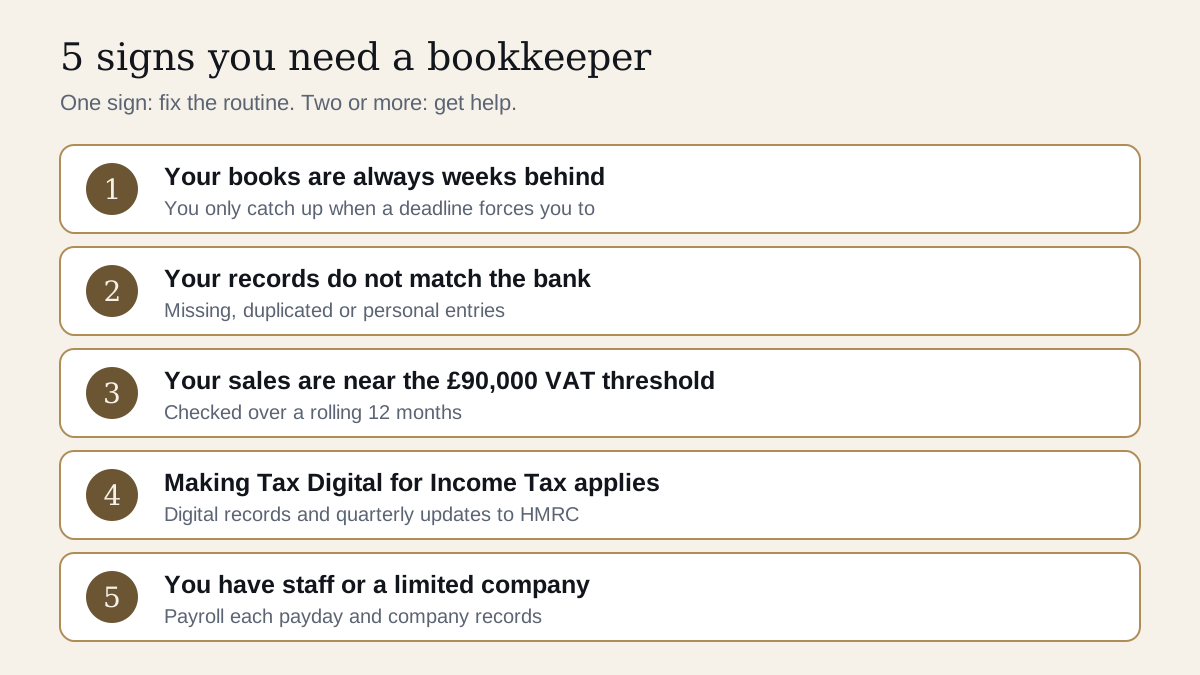
The 5 clearest signs you need a bookkeeper: your books are always behind, your records do not match the bank, or your sales are near the VAT threshold. The other two are Making Tax Digital for Income Tax, and taking on staff or setting up a company.
One sign on its own may only need a better routine. Two or more usually mean the business has outgrown doing its own books.
This guide explains each sign and what to do about it. The GOV.UK figures were checked on 11 November 2026.
By Rehan Razzaq FCCA · Published · 6 min read
The short answer
- Always behind: you only update the books when a deadline forces you to.
- Figures do not match: your records and your bank balance tell two different stories.
- VAT is close: your sales for the last 12 months are near £90,000.
- Making Tax Digital applies: you must keep digital records and send HMRC quarterly updates.
- More moving parts: you now run a payroll, or the business is a limited company.
Why does doing your own books stop working?
At the start, most businesses have a few sales and a few costs each month. A spreadsheet or basic software and an hour on a Sunday is enough.
The problem is not your ability. It is volume and rules. More transactions take more time, and growth brings in VAT, payroll and more frequent reporting to HMRC.
In our experience, the books usually stop in the month the business got busy. By the time the owner notices, there are months of records to rebuild.
1. Are your books always weeks behind?
If you only do the books when a tax return or VAT return is due, they are behind for most of the year. Receipts pile up, and you forget what some payments were for.
That costs you money in two ways. Expenses get missed when nobody records them as they happen. And every decision on prices, hiring or cash is made from old figures.
Software helps, but it only records what you put into it. Our guide to accountant vs software explains where software stops and a person has to check the work.
2. Do your records match your bank balance?
Bank reconciliation means you check every entry in your books against your bank statement. If the two do not agree, something is missing, duplicated or in the wrong place.
Common causes are personal spending through the business account, sales entered twice, and cash payments never recorded. Each one makes your profit figure wrong, so your tax bill is wrong too.
Records are a legal duty, not a nice extra. For a limited company, GOV.UK says "You can be fined £3,000 by HMRC or disqualified as a company director if you do not keep accounting records."
Sole traders must also keep records of "all sales and income" and "all business expenses". Our guide on what records to keep lists them and says how long to keep them.
3. Are your sales getting close to the VAT threshold?
You must register for VAT if your taxable turnover for the last 12 months goes over £90,000. This is a rolling 12 months, not your tax year, so you need to check it every month.
GOV.UK says you must register "within 30 days of the end of the month when you went over the threshold". If your books are behind, you may not know you went over until it is late.
After you register, you must keep some VAT records digitally under Making Tax Digital for VAT, unless you are exempt. Our guide on when to register for VAT covers the rules, and our first VAT return guide covers the first filing.
4. Does Making Tax Digital for Income Tax apply to you?
Making Tax Digital for Income Tax applies to sole traders and landlords whose qualifying income is over a threshold. GOV.UK defines qualifying income as total turnover from self-employment and property, "before expenses".
The thresholds and start dates are:
- Over £50,000 in 2024/25: from 6 April 2026
- Over £30,000 in 2025/26: from 6 April 2027
- Over £20,000 in 2026/27: from 6 April 2028
If you are in, you must use compatible software, keep digital records and send HMRC an update every 3 months. For 2026/27, the updates are due by 7 August, 7 November, 7 February and 7 May.
Four deadlines a year is a big change from one tax return. If you struggle to keep the books current today, a quarterly deadline will show it fast.
5. Have you taken on staff or set up a limited company?
The first employee changes the rhythm. GOV.UK says that on or before each payday, you must report pay and deductions to HMRC in a Full Payment Submission. Our guide on when you need a PAYE scheme explains the set-up.
A limited company adds its own records: money the company receives and spends, stock at the year end, and any money between you and the company. The company's money is not your money, so every transfer needs a record.
If you are still deciding whether to incorporate, our guide to sole trader vs limited company compares the two.
Do you need a bookkeeper, an accountant or better software?
If only the first sign applies, a fixed weekly hour and bank feeds in good software may be enough. Try that for 3 months before you pay anyone.
If two or more signs apply, or VAT, Making Tax Digital or payroll is involved, get help. Choose someone who keeps the books and also understands the tax that comes from them.
If none of these signs apply, you may not need a bookkeeper yet. That is a good position to be in.
What does it cost to hand over the books?
The fee depends mostly on how many transactions you have and how far behind the records are. Our guide to what an accountant costs in London gives typical ranges and how to compare quotes.
Our packages start from £55 a month for Starter, £195 a month for Growth and £375 a month for Established. We confirm the scope and the fee in writing before you commit.
Already have an accountant, but the books are still falling behind? Our guide on how to switch accountants explains the handover.
The bottom line
Doing your own books is fine while they stay current and correct. The signs you need a bookkeeper are about time and risk: records that fall behind or do not match the bank, and new rules that come with growth.
Count the signs that apply to you. One is a warning. Two or more mean the cost of help is likely less than the cost of mistakes.
How REYS Accountants can help
We are a small practice in Catford, SE6. Our bookkeeping service brings your records up to date, keeps them current each month, and feeds them straight into your tax returns and accounts.
See all our services, or get in touch for a quote with no obligation.
Frequently Asked Questions
No. The law requires you to keep proper records, not to pay someone to keep them. Many small businesses do their own books well. A bookkeeper makes sense when the time or the risk of mistakes gets too high.
Not always. Many accountants also keep the books, so one firm does both. If your accountant only does the year-end work, ask whether they can take on the monthly bookkeeping too.
For a simple business, often yes. Software records what you put into it, but it does not check that the entries are right. When the volume or the rules grow, someone has to check the work.
Yes. A bookkeeper can bring the records up to date from your bank statements, invoices and receipts, then keep them current. The sooner you start, the less there is to rebuild.
This article is general guidance for UK businesses and does not constitute personal tax advice. It reflects GOV.UK guidance at 11 November 2026. Rules and individual circumstances vary and can change, always confirm your specific position with a qualified accountant or on gov.uk before acting.

Books falling behind?
Tell us where your records are today, and we will tell you what it takes to bring them up to date, no pressure, no obligation.
Get a quote