Blog
How to Switch Accountants: A Step-by-Step Guide for Small Businesses
You can switch accountants at any time of year. To switch accountants safely, agree the work with your new accountant, give notice to your old one, and let the two accountants hand over your records.
Then authorise the new accountant with HMRC and, for a limited company, change your Companies House code.
This guide covers when to switch, each step in order, what to ask your old accountant for and the mistakes to avoid. The rules were checked on GOV.UK and ACCA guidance on 4 November 2026.
By Rehan Razzaq FCCA · Published · 7 min read
The short answer
- When: any time, but start well before your next deadline, not in the last few weeks.
- Notice: check your engagement letter for the notice period and any fees you still owe.
- Handover: your new accountant contacts the old one, with your permission, and your records move across.
- HMRC: authorise the new accountant as your agent, and remove the old one.
- Companies House: change your company authentication code if your old accountant knows it.
Can I switch accountants at any time?
Yes. You are free to change accountants whenever you want, and you do not need to give a reason. What you must respect is the notice period and the fee terms in your engagement letter.
The timing matters more than the reason. The best time to switch accountants is just after a return is filed, or several months before the next deadline.
Switching a few weeks before 31 January, or before your company accounts are due, leaves little time to fix a slow handover.
Illustrative example: a sole trader whose 2025/26 tax return is due on 31 January 2027 should start the switch in November or early December 2026, not in the middle of January.
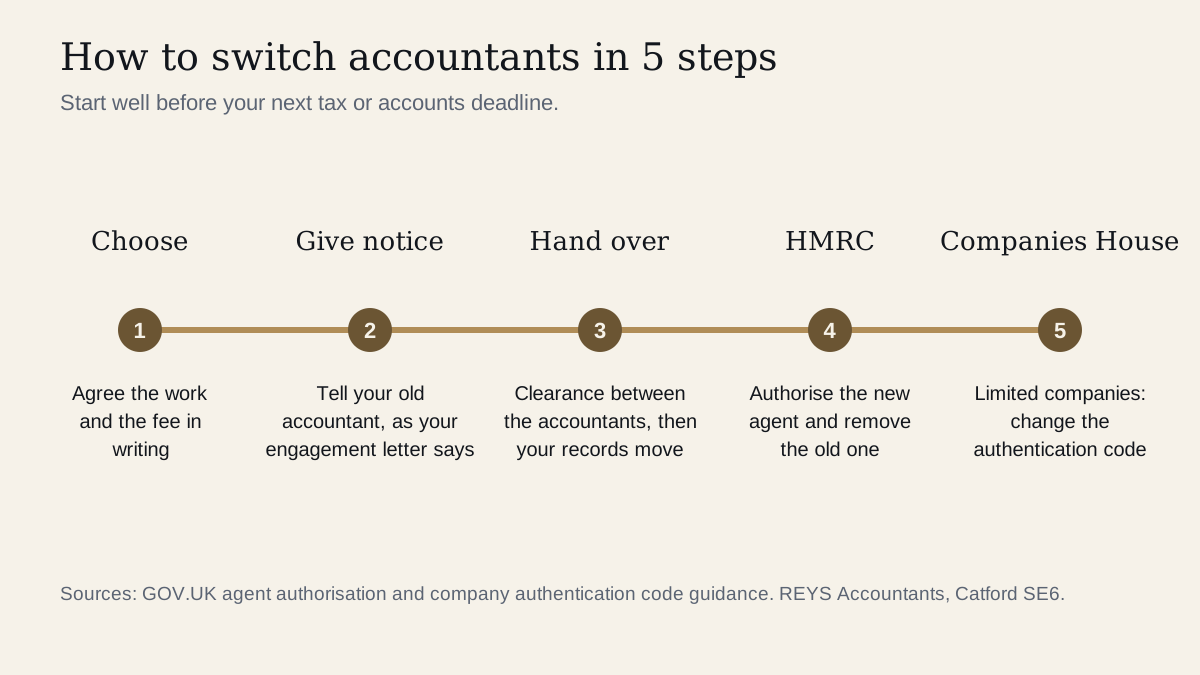
How do I switch accountants, step by step?
- Agree the work with your new accountant. Get the services and the fee in writing, in a letter of engagement, before you leave your old accountant.
- Read your current engagement letter. Note the notice period and any work you have already paid for or still owe for.
- Tell your old accountant in writing. A short email is enough. Say when their work ends and that your new accountant will be in touch.
- Let the accountants talk to each other. Your new accountant will ask your permission to contact your old one. This step is often called professional clearance.
- Get your records handed over. The next section lists what to ask for.
- Authorise your new accountant with HMRC. How you do this depends on the tax. HMRC uses an online service or the paper form 64-8, and your new accountant will tell you which one applies.
- Remove your old accountant's access. HMRC lets you change or remove an agent's authorisation when you no longer want them to act for you.
- Limited companies: deal with Companies House. The section below explains the authentication code.
What should I ask my old accountant for?
ACCA guidance says the former accountant should give the new one "reasonable transfer information" promptly and free of charge. That means a copy of the last accounts you approved and a detailed trial balance that agrees with them.
Ask for these as well, because your new accountant will need them:
- Copies of your last tax returns and tax computations
- Your references: UTR, VAT number, PAYE reference and company number
- Any records, receipts or statements you gave them that they still hold
- Details of any open HMRC letters, enquiries or payment plans
- Access to your bookkeeping software, moved into your own name if the subscription is in theirs
ACCA guidance also says that if you ask again for information you already received, the former accountant can charge for it. Keep the copies they send. Our guide to what records to keep lists what you should hold yourself.
What do I need to do with Companies House?
Every company has a 6-character authentication code. Companies House says it is "the equivalent of a company officer's signature" for online filing.
If your old accountant knows the code, change it. Companies House tells you to do this when someone who is no longer authorised to file for you, such as a previous accountant, knows it.
You change the code in WebFiling, then give the new code to your new accountant.
If you do not have the code, Companies House posts it to your registered office. This can take up to 10 working days, so do not wait until your accounts are due.
Directors must also verify their identity for Companies House. This has been a legal requirement since 18 November 2025. An existing director gives their personal code with the company's next confirmation statement.
An accountant registered as an Authorised Corporate Service Provider can verify your identity for you.
Am I still responsible for my tax when I switch?
Yes. HMRC says that when you use an agent, "You'll still be legally responsible for your own tax". If your agent submits your tax return, you must check the information and confirm it is correct first.
So a deadline does not move because you are between accountants. Late penalties fall on you, not on either accountant. This is the main reason to start early.
What mistakes do people make when they switch accountants?
These problems are common, and each one is easy to avoid:
- Leaving it too late. A switch in the last weeks before 31 January puts the return at risk.
- Not reading the notice terms. A surprise final invoice can slow the handover.
- Forgetting to remove the old agent. Your old accountant may keep access to your HMRC records until you remove it.
- Keeping the old authentication code. Change it so only the people you choose can file for your company.
- Not keeping copies. Save every return and set of accounts your old accountant sends you.
The bottom line
Switching accountants is a routine job when you plan it. Choose your new accountant first, give proper notice, and let the two accountants hand over your records. Then update HMRC and Companies House, and keep copies of everything. Start months before a deadline, not weeks.
How REYS Accountants can help
We are a small practice in Catford, SE6. If you are moving to us from another accountant, we handle professional clearance with your previous accountant and get authorised as your agent with HMRC.
Our three-step plan shows how it works, and our guide to what an accountant costs in London helps you compare quotes. See all our services, or get in touch.
Frequently Asked Questions
Yes. Your new accountant takes over from the point your old one stopped, using your last approved accounts and trial balance. What matters is leaving enough time before your next deadline.
No. You only need to tell them in writing that their work is ending, and follow the notice period in your engagement letter.
ACCA guidance says the basic transfer information, your last approved accounts and a detailed trial balance, should be given free of charge. They can charge if you ask again for information they already gave you.
Remove their authorisation. HMRC lets you change or remove a tax agent's authorisation when you no longer want them to act for you. Your new accountant can show you how.
This article is general guidance for UK businesses and does not constitute personal tax advice. Rules are as published on GOV.UK and in ACCA guidance at 4 November 2026, and the examples are illustrative. Rules and individual circumstances vary and can change, always confirm your specific position with a qualified accountant or on gov.uk before acting.

Thinking of switching?
Book a short call and we'll tell you what the switch involves for your business, no pressure, no obligation.
Book a short call