Blog
Bookkeeping for Small Businesses: What Records to Keep and Why
Bookkeeping records are the evidence behind every figure you give HMRC. Know what records to keep, and your tax return, VAT return or company accounts can be backed up line by line. Get it wrong and HMRC can estimate what you owe.
The rules aren't the same for everyone. Here's what sole traders and limited companies each need to keep, the extra records for VAT and payroll, and how long to hold on to them.
By Rehan Razzaq FCCA · Published · 7 min read
The short answer
- Everyone: a record of every sale and every business cost, with the invoice, receipt or bank line that proves it.
- Limited companies also keep statutory records, such as shareholders and resolutions, plus a director's loan account.
- VAT-registered businesses and employers keep extra records, partly in digital form.
- How long: from 3 years for payroll to 6 years for company accounts or VAT, about 5 years 10 months from the end of the tax year for a sole trader, and 10 years for company minutes and resolutions.
What bookkeeping records does every small business need?
Whatever your business structure, every transaction needs two things: a record in your books and the document behind it.
- Sales: the invoices you issue, or till reports and daily takings if you sell over the counter.
- Costs: purchase invoices and receipts, showing who you paid, what for and when.
- Bank and card statements for every account the business uses, so each record can be matched to money actually moving.
- Anything you own or owe: equipment and vehicles bought, loans, and money customers still owe you.
A bank statement on its own isn't enough. It proves money left the account, but not what it bought or whether it was a business cost at all. The receipt answers that.
What records does a sole trader need to keep?
GOV.UK's list for the self-employed is short: all sales and income, all business expenses, VAT and payroll records if they apply, and records of your personal income, such as a job, savings or rent.
The cash basis is now the standard for sole traders, recording income and costs when money is received or paid. You can use traditional accounting, by invoice date, but must say so on your tax return.
If something is used partly privately, such as a phone or a car, keep a note of how you worked out the business share. Our guide to what sole traders can claim covers which costs count.
When do a sole trader's records have to be digital?
Under Making Tax Digital for Income Tax, sole traders and landlords must keep digital records once their qualifying income passes a threshold. That's turnover from self-employment and property before expenses, not profit.
The threshold was £50,000 from 6 April 2026. It falls to £30,000 from 6 April 2027 and £20,000 from 6 April 2028.
Each digital record needs the amount, the date and a category, kept in compatible software. Spreadsheets are still allowed with bridging software. Our Self Assessment page explains how the quarterly updates fit around your return.
What records does a limited company need to keep?
A company has two sets of records to keep, and owners often only know about the first. Both are on GOV.UK's page on company and accounting records.
- Accounting records: all money received and spent, assets, debts owed to and by the company, stock at the year end, and the receipts, invoices and bank statements behind your accounts and Company Tax Return.
- Company records: shareholders, shareholder votes and resolutions, share transactions, and loans or mortgages secured on company assets.
Minutes and resolutions have a longer clock than the accounts. Under the Companies Act 2006, minutes of directors' meetings (section 248) and records of shareholder resolutions and meetings (section 355) must be kept for at least 10 years from the date.
If the records aren't kept at the registered office address, you must tell Companies House where they are.
Why does a company need a director's loan account?
Money you take from the company that isn't salary, a dividend or a repaid expense is a director's loan. You must record any money you borrow from or pay into the company, and that record is your director's loan account.
This is one of the records most often missing when a new company client comes to us. Personal spending on the company card goes in it too. Dividends need their own paperwork, which our dividends vs salary guide sets out.
What extra records apply for VAT and payroll?
If you're VAT-registered, you record everything you buy and sell, including zero-rated and exempt items, plus a VAT account: the VAT charged and paid that feeds each return. Some of it must be kept digitally under Making Tax Digital for VAT.
To reclaim VAT on a purchase you need a valid VAT invoice, not just a card receipt. Our VAT returns service, our guide on when to register for VAT and our guide to how your first VAT return works cover the rest.
If you employ anyone, including yourself as a director, payroll records include pay and deductions, reports and payments to HMRC, leave and sickness, tax code notices, and taxable expenses or benefits. Our payroll service keeps these for you, and our guide on when you need a PAYE scheme covers setting one up.
How long do you need to keep business records?
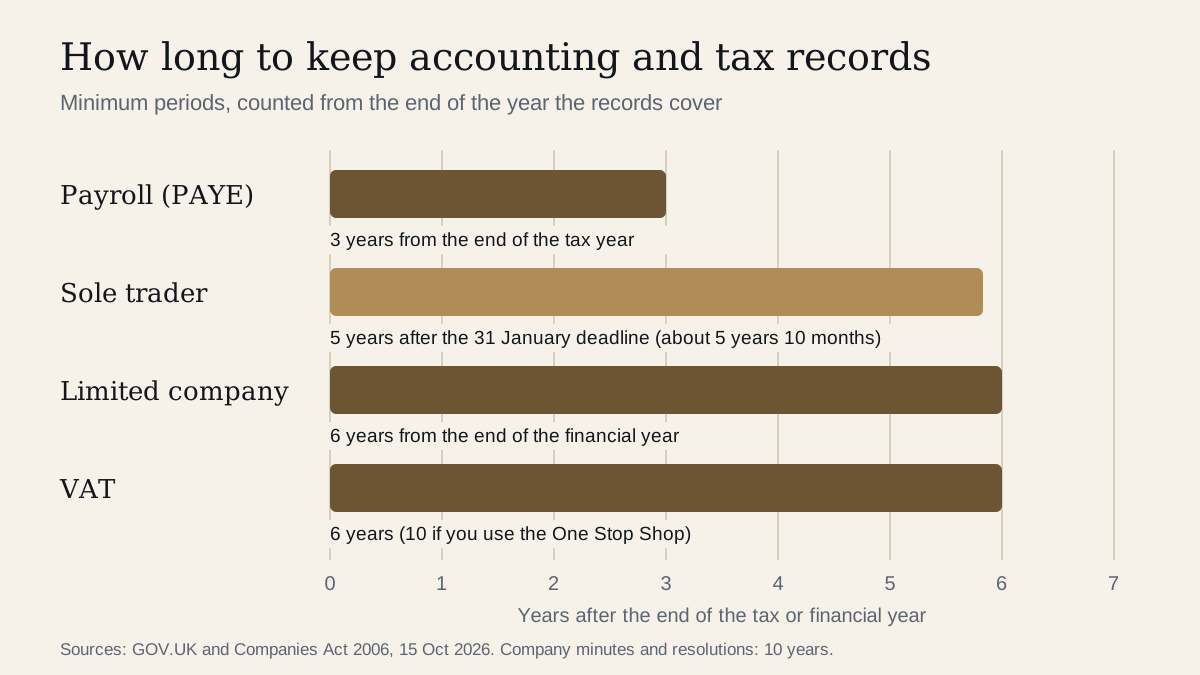
Each rule is counted from a different date, which is where people trip up. All five below were checked on GOV.UK or legislation.gov.uk on 15 October 2026.
| Records | Keep for at least | Example |
|---|---|---|
| Sole trader (source) | 5 years after the 31 January filing deadline | 2025/26 records: until 31 January 2032 |
| Limited company accounting and tax records (source) | 6 years from the end of the financial year | Year to 31 March 2026: until 31 March 2032 |
| Company minutes and resolutions (Companies Act 2006, sections 248 and 355) | 10 years from the meeting, resolution or decision | Board meeting on 1 June 2026: until 1 June 2036 |
| VAT (source) | 6 years | 10 years if you use the One Stop Shop schemes |
| Payroll (source) | 3 years from the end of the tax year | 2025/26 records: until 5 April 2029 |
Some records need keeping longer, such as a company's records after a late Company Tax Return, during an HMRC compliance check, or for an asset lasting over 6 years. A sole trader filing over 4 years late keeps records for 15 months after filing.
In practice, a record often serves more than one rule. A purchase invoice for a VAT-registered company counts for both VAT and Corporation Tax, so keep it for whichever period ends later.
Why does keeping records matter?
- Penalties: HMRC can charge up to £3,000 for failing to keep adequate records for Self Assessment, and the same for a company, where a director can also be disqualified.
- Proving your figures: if HMRC checks a return, the records are your evidence. Without them, it can work out what it thinks you owe.
- Claiming what you're owed: a cost with no receipt is a cost that tends not to get claimed, or a VAT reclaim you can't support.
What do small businesses most often get wrong?
These are the gaps we see most when we take over someone's books in Catford and across South East London:
- One bank account for everything. Business and personal spending mixed together means every line has to be explained later. A separate account removes most of that work.
- Binning records once the return is filed. Filing starts the clock. It doesn't end it.
- Recording payouts, not sales. Card terminals and online platforms often pay out after deducting their fees. The sale and the fee each need recording, not just the net amount. Our page for high-street businesses in Lewisham covers this in more detail.
- No paperwork for money a director takes out. Without a dividend record or loan account entry, nobody can say later what the payment was.
In short: what records to keep, and for how long
Keep a record of every sale and cost with the document behind it, and match them to your bank. Add the statutory registers and a loan account if you're a company, and the VAT and payroll records if they apply.
Then keep everything for the longest period that applies. For most small businesses, holding accounting and tax records for 6 years after the end of the year they cover, plus any open check, meets every deadline above. A company's minutes and resolutions need 10.
How REYS Accountants can help
We're a small practice in Catford, SE6. Our bookkeeping service keeps your records reconciled with the evidence attached, so your year-end accounts or tax return rest on records that hold up. Get in touch if your books need sorting out.
Frequently Asked Questions
Not on its own. A bank statement shows that a payment was made, but not what it was for. Keep the invoice or receipt too, and if you're VAT-registered you need a valid VAT invoice to reclaim the VAT.
Generally, yes. HMRC's VAT record-keeping notice accepts a scanned image in place of the paper original, as long as it shows all the detail needed. A few documents must be kept in their original form, such as the C79 import VAT certificate.
No. It covers sole traders and landlords registered for Self Assessment. A company pays Corporation Tax, not Income Tax, so its own records are outside it. A VAT-registered company still keeps digital VAT records under Making Tax Digital for VAT.
Try to replace them first, for example by asking suppliers for copy invoices or downloading old bank statements. If that isn't possible, HMRC expects your best estimate, and you tell it which figures are estimated or provisional when you file.
This article is general guidance for UK businesses and individuals and does not constitute personal tax advice. Figures and rules are as published on GOV.UK at 15 October 2026, and any examples are illustrative. Rates, thresholds and individual circumstances vary and can change, so always confirm your specific position with a qualified accountant or on GOV.UK before acting.

Books in a mess?
Book a short call and we'll tell you what's missing and how to get it back on track, no pressure, no obligation.
Book a short call