Blog
Payroll for Small Employers: When You Need to Run a PAYE Scheme
A PAYE scheme is how an employer takes Income Tax and National Insurance from pay and reports it to HMRC. When do you need a PAYE scheme? Usually before the first payday of the first person you pay, including yourself as a director.
Here's the test HMRC uses, what changes for a one-director company, and what running payroll involves each month, with the 2026/27 figures checked on GOV.UK on 22 October 2026.
By Rehan Razzaq FCCA · Published · 7 min read
The short answer
- You need a PAYE scheme if you pay anyone £96 or more a week, or they get expenses or benefits, a pension, or have had another job this tax year.
- A director counts. A one-person limited company paying its director a salary must register as an employer.
- Register before the first payday, but not more than 2 months before it.
- After that, report pay to HMRC on or before every payday, and pay HMRC by the 22nd of the next month.
When do you need a PAYE scheme?
GOV.UK's PAYE for employers guide says you must register if any of these apply to an employee in the current tax year, which starts on 6 April:
- they're paid £96 or more a week
- they get expenses or company benefits
- they're getting a pension
- they've had another job since 6 April
- they've received Jobseeker's Allowance, Employment and Support Allowance or Incapacity Benefit
The £96 a week matches the point where employer National Insurance starts: £417 a month, or £5,000 a year, in the 2026/27 rates and thresholds.
It fell to that level in April 2025, so a part-timer on a few hours a week can now bring you into PAYE.
Once you run a PAYE scheme, everyone you pay goes through it, including staff below £96 a week.
Do you need a PAYE scheme as the only director?
Yes, if the company pays you a salary. GOV.UK's register as an employer page is direct: you must register "even if you're only employing yourself", for example as the only director of a limited company.
Most directors take a salary of £12,570, well over £96 a week, with the rest as dividends. Our dividends vs salary guide explains why. Dividends don't go through payroll.
Two things work differently for a one-director company with no other staff:
- No Employment Allowance. The eligibility rules say the director must not be the only employee paying employer National Insurance.
- No pension auto-enrolment duties. The Pensions Regulator says a sole director with no other staff has none, but you still tell it you're not an employer.
How do you register as an employer?
Most limited companies register online. You have to do it before your first payday, and you can't register more than 2 months before you start paying people.
HMRC sends your employer PAYE reference by letter, and GOV.UK gives no fixed time for it. If payday comes first, run the payroll, store the report and send it to HMRC as a late submission once the reference arrives.
What does running a PAYE scheme involve?
Each pay period, GOV.UK's running payroll guide expects you to:
- Record each person's pay and work out Income Tax, employee and employer National Insurance, and any student loan or pension deductions.
- Give each employee a payslip.
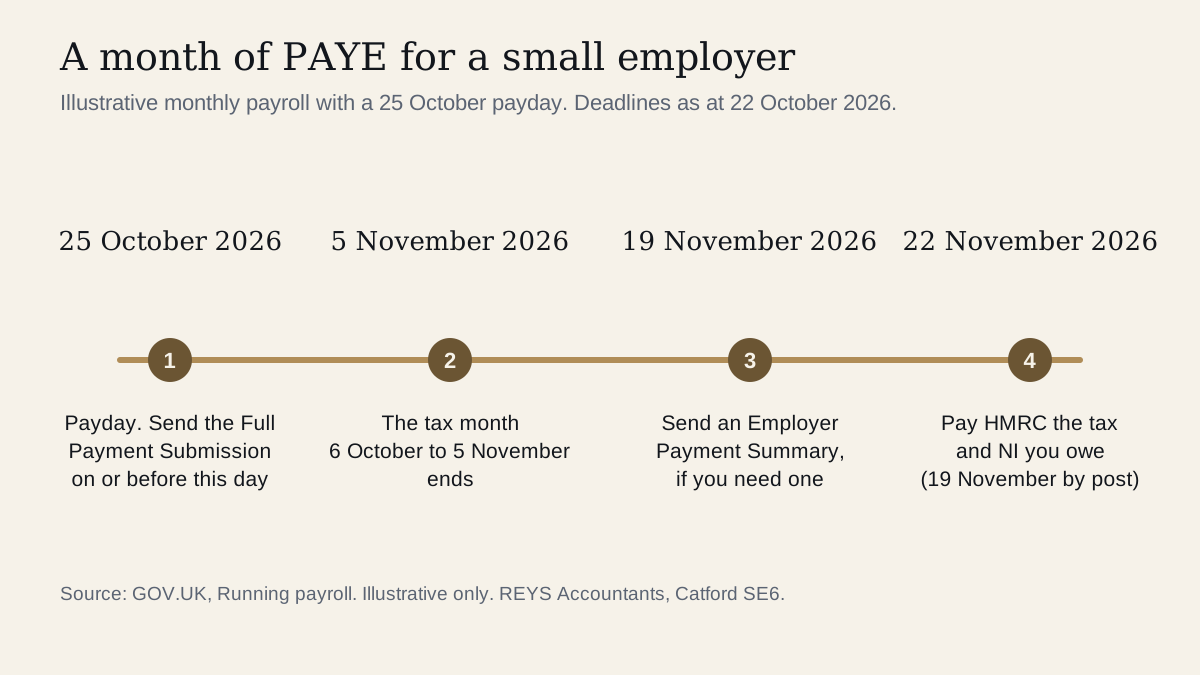
- Send a Full Payment Submission (FPS) to HMRC on or before payday.
- Send an Employer Payment Summary (EPS) by the 19th of the next tax month if you paid nobody, or to claim reductions such as the Employment Allowance.
- Pay HMRC by the 22nd of the next tax month, or the 19th if you pay by post.
A tax month runs from the 6th to the 5th. If you usually owe HMRC less than £1,500 a month, you may be able to pay quarterly, but the FPS still goes in every payday.
What happens at the end of the tax year?
Send your final FPS on or before the last payday before 5 April. Give a P60 to everyone on your payroll on 5 April by 31 May. Report any taxable expenses and benefits by 6 July.
Keep payroll records for at least 3 years from the end of the tax year they cover. Our guide on what records to keep lists them.
What are the 2026/27 payroll figures?
All of these were checked on GOV.UK or the Pensions Regulator's site on 22 October 2026. National Insurance is the same across the UK, but Income Tax bands are different in Scotland.
| Figure | 2026/27 |
|---|---|
| Personal allowance (tax code 1257L) | £12,570 a year (£1,048 a month) |
| Income Tax, England, Wales and Northern Ireland | 20% on the first £37,700 above the allowance, 40% to £125,140, 45% above |
| Lower earnings limit | £129 a week, £6,708 a year |
| Employer NI starts (secondary threshold) | £96 a week, £417 a month, £5,000 a year |
| Employee NI starts (primary threshold) | £242 a week, £1,048 a month, £12,570 a year |
| Upper earnings limit | £967 a week, £50,270 a year |
| Employee NI (category A) | 8% between the thresholds, 2% above £50,270 |
| Employer NI | 15% above £5,000 a year |
| Employment Allowance | Up to £10,500 a year |
| National Living Wage (21 and over) | £12.71 an hour from 1 April 2026 |
| National Minimum Wage, 18 to 20 | £10.85 an hour |
| Pension auto-enrolment trigger | £10,000 a year |
| Pension qualifying earnings | £6,240 to £50,270 a year |
How does pension auto-enrolment fit in?
Your workplace pension duties start the day your first member of staff starts. You must enrol anyone aged 22 up to State Pension age who earns at least £10,000 a year and normally works in the UK.
The legal minimum is 8% of qualifying earnings, of which the employer pays at least 3%. For 2026/27, qualifying earnings are pay between £6,240 and £50,270 a year, according to the Pensions Regulator.
What does a first hire cost to run through PAYE?
Take an illustrative example: a Catford café owner takes on a part-timer aged 25 for 20 hours a week at the £12.71 National Living Wage. That's £254.20 a week, so a PAYE scheme is needed.
- Employer National Insurance: 15% of the £158.20 over £96, about £23.73 a week, or roughly £1,234 a year.
- Employee deductions: about £0.98 a week National Insurance and around £2.40 Income Tax on a 1257L tax code.
- Pension: pay of about £13,218 a year is over £10,000, so they're auto-enrolled. The employer minimum is about £4 a week.
If the business is eligible for the Employment Allowance, it covers that employer National Insurance in full. The figures are rounded and assume a 52-week year.
What do new employers most often get wrong?
These are the gaps we see most when new employers in Catford and across South East London come to us:
- Paying a director's salary before registering. The company then starts its PAYE record with late reports.
- Assuming a small wage means no payroll. A part-timer under £96 a week who has another job still brings you into PAYE.
- Missing the EPS. In a month with no pay, HMRC expects one. Without it, HMRC may assume you owe something.
- Forgetting the Pensions Regulator. A sole director with no duties still needs to tell it so.
Our page for businesses in Sydenham and Penge covers the other first-hire duties, such as right-to-work checks and employers' liability insurance.
In short: when you need to run a PAYE scheme
If you pay anyone £96 or more a week, including yourself as a director, or one of the other conditions applies, you need a PAYE scheme before the first payday. Register no more than 2 months ahead.
From then on, the routine is fixed: a report on or before every payday, payment by the 22nd, and P60s each May. Getting the set-up right is the hard part. After that, most months are routine.
How REYS Accountants can help
We're a small practice in Catford, SE6. Our payroll service registers you as an employer, runs each pay period and sends the HMRC and pension reports for you. Get in touch before your first payday.
Frequently Asked Questions
Yes, if you pay yourself a salary. GOV.UK says you must register as an employer even if you only employ yourself, for example as the only director of a limited company. Dividends on their own don't go through payroll.
Yes. You need payroll software that can send reports to HMRC, and you have to keep up with every payday and monthly deadline. Many small employers start this way and hand it over once they take on more staff.
Not always. You still need to operate PAYE if they get expenses or benefits, get a pension, have had another job since 6 April, or have claimed certain benefits. If you already run a PAYE scheme, you report them through it anyway.
With 1 to 9 employees, HMRC can charge £100 for each month a report is late. Your first late report in a tax year isn't penalised, nor is one sent within 3 days of payday, though HMRC can still look at regular lateness.
This article is general guidance for UK businesses and individuals and does not constitute personal tax advice. Figures and rules are as published on GOV.UK and by the Pensions Regulator at 22 October 2026, and any examples are illustrative. Rates, thresholds and individual circumstances vary and can change, so always confirm your specific position with a qualified accountant or on GOV.UK before acting.

Taking on your first employee?
Book a short call and we'll tell you what you need to set up before payday, no pressure, no obligation.
Book a short call