Blog
VAT Returns Made Simple: A Guide to Your First VAT Return
Your first VAT return tells HMRC how much VAT you charged on sales and paid on costs in one period. You pay the difference, or HMRC repays you. The return and payment are both due one calendar month and 7 days after the period ends.
This guide covers when your first VAT return is due, what goes in each box, how to file it step by step and the mistakes first-time filers make. All figures were checked on GOV.UK on 29 October 2026.
By Rehan Razzaq FCCA · Published · 8 min read
The short answer
- What it is: a summary of the VAT on your sales minus the VAT on your purchases for one period, usually 3 months.
- Deadline: one calendar month and 7 days after the period ends. The payment has the same deadline.
- How to file: through software that works with Making Tax Digital (MTD), unless HMRC has given you an exemption.
- Nothing to report: you must still file. A nil return that is late gets a penalty point like any other.
- Late: penalty points for late returns, penalties for VAT paid 16 or more days late, and interest from the first day.
What is a VAT return?
Once you are VAT-registered, you add VAT to most of your sales and you can reclaim VAT on most business costs. The VAT return is how you report both figures to HMRC.
If you charged more VAT than you paid, you pay HMRC the difference. If you paid more than you charged, HMRC repays you. Most sales are at the 20% standard rate, and some are at 5% or 0%.
HMRC says you usually send a VAT return every 3 months. Monthly returns are possible, and the Annual Accounting Scheme lets you file once a year, with the return due 2 months after the end of the year.
When is my first VAT return due?
When you register, HMRC sends you your 9-digit VAT number and your effective date of registration. It also tells you when to submit your first return and make your first payment.
Use the dates HMRC gives you, which also show in your VAT online account. Do not assume your VAT periods match your tax year, your accounting year or the calendar quarters.
Every VAT return is due one calendar month and 7 days after the end of the period, and that is also the payment deadline. The deadline stays the same when it falls on a weekend or a bank holiday.
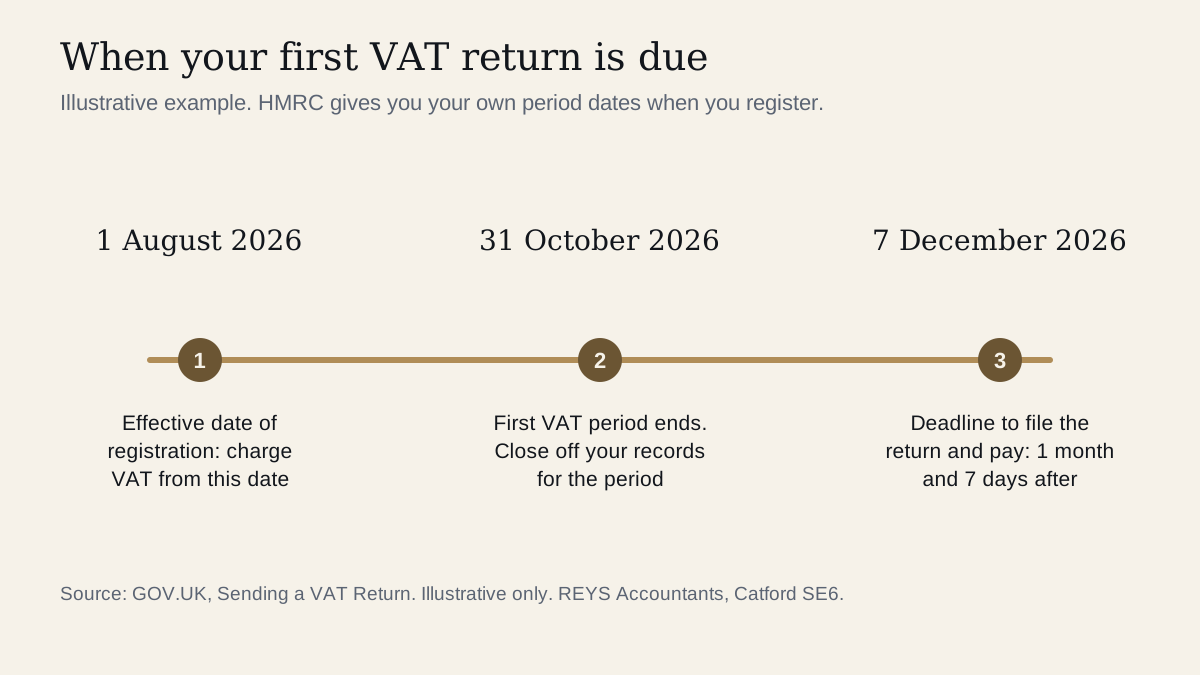
Illustrative example: you are VAT-registered from 1 August 2026, and HMRC sets your first period as 1 August to 31 October 2026. Your return and your payment must reach HMRC by 7 December 2026.
If you pay by Direct Debit, HMRC takes the money 3 working days after the deadline. Set up the Direct Debit at least 3 working days before you submit the return. If you pay another way, allow time for the money to reach HMRC.
What goes on a VAT return? The 9 boxes
Your software fills in the boxes from your records. You still need to know what each box means, because you are responsible for the figures you submit.
| Box | What goes in it |
|---|---|
| 1 | VAT due on your sales in the period |
| 2 | VAT due on goods brought into Northern Ireland from the EU. For most businesses this is 0. |
| 3 | Total VAT due: box 1 plus box 2 |
| 4 | VAT you reclaim on business purchases |
| 5 | Box 3 minus box 4: the VAT you pay, or the amount HMRC repays |
| 6 | Total value of all your sales, without VAT |
| 7 | Total value of your purchases and expenses, without VAT |
| 8 | Goods sent from Northern Ireland to the EU, without VAT. For most businesses this is 0. |
| 9 | Goods brought into Northern Ireland from the EU, without VAT. For most businesses this is 0. |
Boxes 1 to 5 are VAT. Boxes 6 to 9 are the values before VAT. HMRC explains each box in VAT Notice 700/12.
How do I file my first VAT return, step by step?
- Sign up for your VAT online account as soon as you get your VAT number. HMRC signs most new businesses up to Making Tax Digital for VAT for you.
- Choose software that works with Making Tax Digital and connect it to HMRC. GOV.UK keeps a list of compatible products.
- Record every sale and purchase for the period in the software, from your effective date of registration. Keep a valid VAT invoice for each cost you reclaim VAT on.
- Check the figures before you submit. Look at the mistakes in the next section.
- Review boxes 1 to 9 and submit the return through your software before the deadline.
- Pay any VAT due so that it reaches HMRC by the deadline, or make sure your Direct Debit is in place.
- Keep your VAT records, digital ones included, for at least 6 years. Our guide to what records to keep lists them.
You must submit through MTD-compatible software. Only businesses with an exemption can file by post or in the VAT online account, and HMRC can charge up to £400 for a paper return sent without one.
What do first-time filers most often get wrong?
The same few errors come up again and again when we look at a business's first VAT return:
- Starting VAT on the wrong date. VAT is due from your effective date of registration, not the date your VAT number arrived. Sales made in the gap still count.
- Reclaiming VAT without a valid VAT invoice. HMRC says you must have valid VAT invoices. A supplier who is not VAT-registered cannot charge you VAT.
- Reclaiming VAT on client entertaining. You cannot reclaim VAT on entertaining or hospitality for people you do business with, such as theatre or sports tickets.
- Reclaiming all the VAT on mixed-use items. If you use something partly for personal reasons, such as a mobile phone, you can only reclaim the business share.
- Skipping a quiet quarter. You must file even when you have no VAT to pay or reclaim.
- Paying on the deadline day. The money must reach HMRC by the deadline, so a bank transfer sent late on that day may arrive too late.
Costs from before you registered follow their own time limits. Our guide to when you need to register for VAT explains them.
What happens if my VAT return is late?
For VAT periods that started on or after 1 January 2023, HMRC uses a points system for late returns and separate penalties for late payment.
- Late returns: each late return gets 1 penalty point, nil returns included. At 4 points for quarterly filers (2 for annual, 5 for monthly), you get a £200 penalty, and £200 more for each late return after that.
- Late payment, days 1 to 15: no penalty, but interest starts from the first day.
- Days 16 to 30: a first penalty of 3% of the VAT still unpaid at day 15.
- Day 31 onwards: another 3% of the amount unpaid at day 30, plus a second penalty at 10% a year, charged daily until you pay.
Late payment interest is the Bank of England base rate plus 4%. The sources are HMRC's pages on late submission penalty points, late payment penalties and late payment interest.
If you cannot pay in full, contact HMRC before the deadline. Interest still runs on a payment plan, but early contact keeps your options open.
What if I make a mistake on a VAT return?
You can correct errors from the previous 4 years. You can fix the error on your next return if its net value is £10,000 or less, or between £10,000 and £50,000 but less than 1% of your total sales.
Larger errors, and any deliberate error, must be reported to HMRC separately. HMRC can charge a penalty of up to 100% of the tax under-stated or over-claimed, so correct a mistake as soon as you find it.
The bottom line
Your first VAT return is easier than it looks once your records are digital and current. Use the period dates HMRC gives you and charge VAT from your effective date. Reclaim only what you hold valid invoices for, and pay on time.
How REYS Accountants can help
We are a small practice in Catford, SE6, and many of our clients come to us just after they register for VAT.
As your VAT accountant, we set up your Making Tax Digital software, check every figure and file each return on time. Our bookkeeping service keeps the records behind it up to date. Not sure where you stand? Get in touch.
Frequently Asked Questions
Yes. If you are VAT-registered, you must submit a VAT return even when you have no VAT to pay or reclaim. A late nil return gets a penalty point.
Not normally. You must use software that works with Making Tax Digital. Only businesses that HMRC has exempted from Making Tax Digital can file in the VAT online account or by post.
By the same deadline as the return: one calendar month and 7 days after the period ends. The money must reach HMRC by then. A Direct Debit is taken 3 working days after the deadline.
A late return gets 1 penalty point. A quarterly filer gets a £200 penalty only at 4 points. Late payment is separate: interest starts from day 1, and penalties start if the VAT is still unpaid after 15 days.
Yes, for the previous 4 years. Errors with a net value of £10,000 or less, or up to £50,000 if under 1% of your total sales, can go on your next return. Larger or deliberate errors must be reported to HMRC separately.
This article is general guidance for UK businesses and does not constitute personal tax advice. Figures and rules are as published on GOV.UK at 29 October 2026, and the examples are illustrative. Rules and individual circumstances vary and can change, always confirm your specific position with a qualified accountant or on gov.uk before acting.

First VAT return coming up?
Book a short call and we'll check your period dates and your records before the deadline, no pressure, no obligation.
Book a short call