Blog
What to Bring to Your First Meeting with an Accountant
For your first meeting with an accountant, bring photo ID, proof of address, your tax references and your last tax return or set of accounts. Add a rough idea of your income and any recent HMRC letters.
You do not need a box of receipts. The first meeting is for the accountant to understand your position and quote for the work.
This guide gives the list for each type of business, explains why accountants ask for ID, and tells you what not to hand over. The GOV.UK guidance was checked on 9 November 2026.
By Rehan Razzaq FCCA · Published · 6 min read
The short answer
- Identity: a passport or driving licence, and a recent bill or bank statement with your address.
- Tax references: your UTR and National Insurance number, plus your company, VAT and PAYE references if you have them.
- Last filings: your last tax return, or your company's last accounts and Corporation Tax return.
- Numbers: a rough figure for your income or turnover, and how you keep your records today.
- Letters: anything recent from HMRC or Companies House, especially penalties or deadlines.
What is the first meeting with an accountant for?
The first meeting is a fact-find. The accountant learns what your business does, which taxes apply to you and what is due soon. Then they can tell you what work you need and what it will cost.
It is not the meeting where your tax return gets done. So bring summaries and references, not every invoice and receipt for the year.
A good first meeting ends with a clear next step: a written quote, then a letter of engagement that sets out the work and the fee.
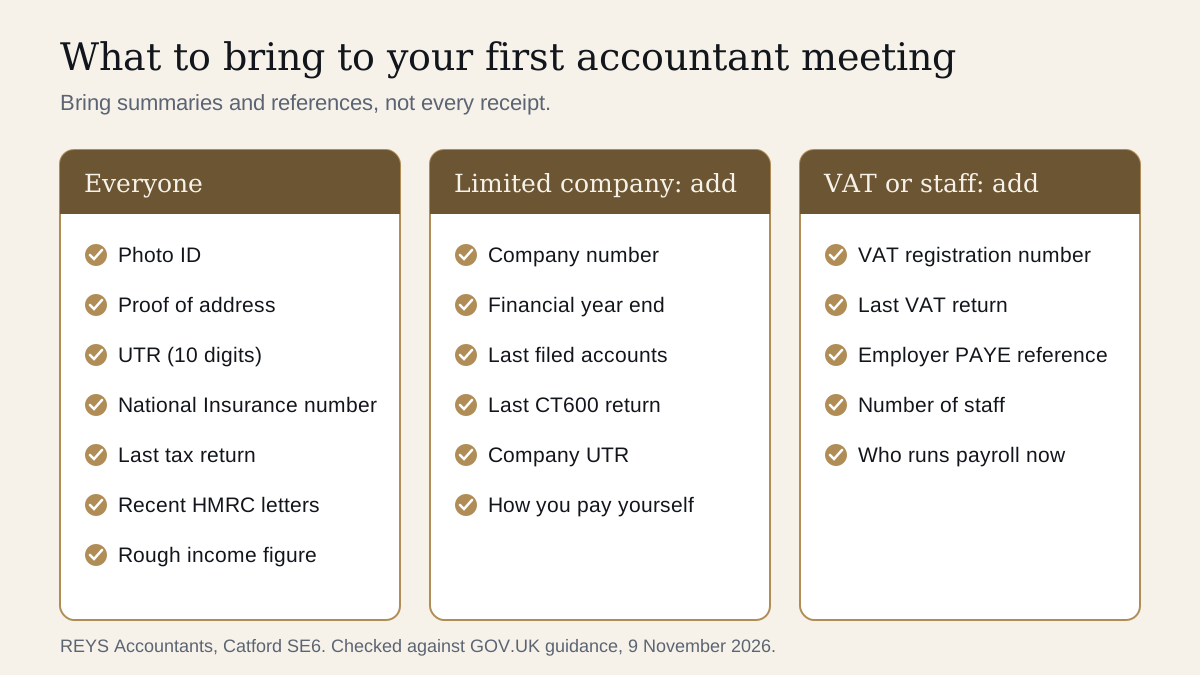
What should everyone bring to a first meeting with an accountant?
Whatever your business, these items let the accountant check who you are and find your tax records:
- Photo ID and proof of address. The next section explains why the accountant needs these.
- Your UTR. HMRC says it is "a 10-digit number". You find it in your Personal Tax Account, the HMRC app, or old tax returns and HMRC letters.
- Your National Insurance number. It is 2 letters, 6 numbers and a final letter, and it is on your payslips and P60.
- Your last tax return, or the tax calculation HMRC sent you after it.
- Recent HMRC letters, such as a penalty notice, a payment reminder or a notice to file a return.
- Your other income, in outline: a job, rent, dividends or savings interest.
If you have never registered with HMRC, say so. That is common, and the accountant will tell you what to register for first.
What extra should a sole trader bring?
A sole trader should bring the basic facts about the business, not the full year's records:
- The date you started trading, and what you sell or do
- A rough figure for your yearly income before expenses
- How you keep records now: software, a spreadsheet or a bag of receipts
- Whether you work under the Construction Industry Scheme (CIS)
The income figure matters because it decides which rules apply, for example for Making Tax Digital. When the work starts, our first Self Assessment checklist lists the records to gather for the return itself.
What extra should a limited company director bring?
For a company, the accountant needs to see where the company stands with Companies House and HMRC:
- The company name and company number
- The company's financial year end
- The last filed accounts and the last Corporation Tax return (CT600)
- The company's Corporation Tax UTR
- How you pay yourself: salary, dividends or both
- Any money you owe the company, or the company owes you
If you cannot find the company's UTR, HMRC lets you request it online. HMRC posts it to the address registered with Companies House, so ask early.
You do not need your Companies House authentication code at a first meeting. If you move to a new accountant, our guide to how to switch accountants explains the code and the handover from your old accountant.
What should you bring if you are VAT-registered or have staff?
If you are registered for VAT, bring your VAT registration number and your last VAT return. Tell the accountant which VAT scheme you use, if you know it.
If you employ anyone, bring your employer PAYE reference and the number of people on your payroll. Say who runs the payroll today and how often you pay staff.
Not registered for VAT yet, but your sales are growing? Bring a month-by-month sales figure, so the accountant can check it against the VAT registration threshold.
Why does an accountant ask for ID at the first meeting?
Accountants must follow the money laundering rules. HMRC says a business must apply customer due diligence "when you establish a business relationship with a customer".
HMRC explains that customer due diligence "means taking steps to identify your customers and checking they are who they say they are". The accountant must also understand the purpose of the work.
So an ID request is a legal step, not a sign of distrust. Bringing your ID to the first meeting means the work can start sooner.
What should you not hand over?
Do not give an accountant your HMRC sign-in details. HMRC has a proper process to authorise an agent, and the accountant then uses their own access to deal with your tax.
HMRC also says that with an agent, "You'll still be legally responsible for your own tax". So keep copies of everything you hand over, and check each return before it is filed.
You also do not need to bring original documents to keep. A copy or a photo is usually enough until the work begins.
What should you decide before the meeting?
Bring a short note of what you want help with. For example: "my tax return only", or "bookkeeping, VAT and payroll every month".
Note any deadline in the next three months, and any problem that worries you, such as a late return. The more the accountant knows, the more accurate the quote.
If you are still choosing an accountant, our guide to the questions to ask before hiring an accountant lists what to check. Our guide to what an accountant costs in London shows how to compare quotes.
The bottom line
Prepare for a first meeting with an accountant by bringing who you are, your tax references and your last filings. Add a rough income figure, recent HMRC letters and a note of what you want.
That is enough for an accurate quote. Leave the receipts and the sign-in details at home.
How REYS Accountants can help
We are a small practice in Catford, SE6, and our first call is free with no obligation. Bring what you have from the list above, and we will tell you what work you need and what it costs.
See all our services, our packages, or get in touch.
Frequently Asked Questions
No. A rough income figure and an idea of how you keep records is enough. The accountant asks for the detailed records when the work starts.
Look in your Personal Tax Account, the HMRC app, or old HMRC letters. A company can request its Corporation Tax UTR online. Do not cancel the meeting because of it.
No. You authorise the accountant as your agent with HMRC, and they use their own access. Keep your sign-in details to yourself.
The money laundering rules require accountants to identify a new client and check they are who they say they are before the work starts.
This article is general guidance for UK businesses and does not constitute personal tax advice. It reflects GOV.UK guidance at 9 November 2026. Rules and individual circumstances vary and can change, always confirm your specific position with a qualified accountant or on gov.uk before acting.

Ready for a first call?
Book a free first call. Bring what you have, and we will tell you what you need, no pressure, no obligation.
Book a short call