Blog
Questions to Ask Before Hiring an Accountant in London
The questions to ask before hiring an accountant are about trust first and price second. Ask who regulates them, who supervises them for money laundering, what the fee covers in writing, who does your work and which software they use.
London has a lot of choice, and HMRC warns that anyone can call themselves a tax agent. Ten questions, asked before you sign, sort the qualified and careful from the rest.
This guide gives each question, the answer to listen for and how to check it. The GOV.UK and ACCA guidance was checked on 12 November 2026.
By Rehan Razzaq FCCA · Published · 7 min read
The short answer
- Regulation: which professional body are you a member of, and can I check it?
- Protection: do you hold a practising certificate and professional indemnity insurance?
- Supervision: who supervises you for anti-money laundering, and are you registered with HMRC as a tax adviser?
- Terms: what does the fee include, and will I get an engagement letter?
- Service: who does my work, how fast do you reply, and which software do you use?
Why ask questions before hiring an accountant?
"Accountant" is not a protected title in the UK. HMRC's guide on how to choose a tax agent says: "anyone can call themselves a tax agent". It adds that "HMRC does not regulate agents".
The same guide says that "you remain responsible for your own tax affairs" even with an agent. A careless accountant's mistake can become your penalty. So the questions below protect you, not the accountant.
This guide is about choosing who to hire. If you have already chosen and want to prepare, see what to bring to your first meeting with an accountant.
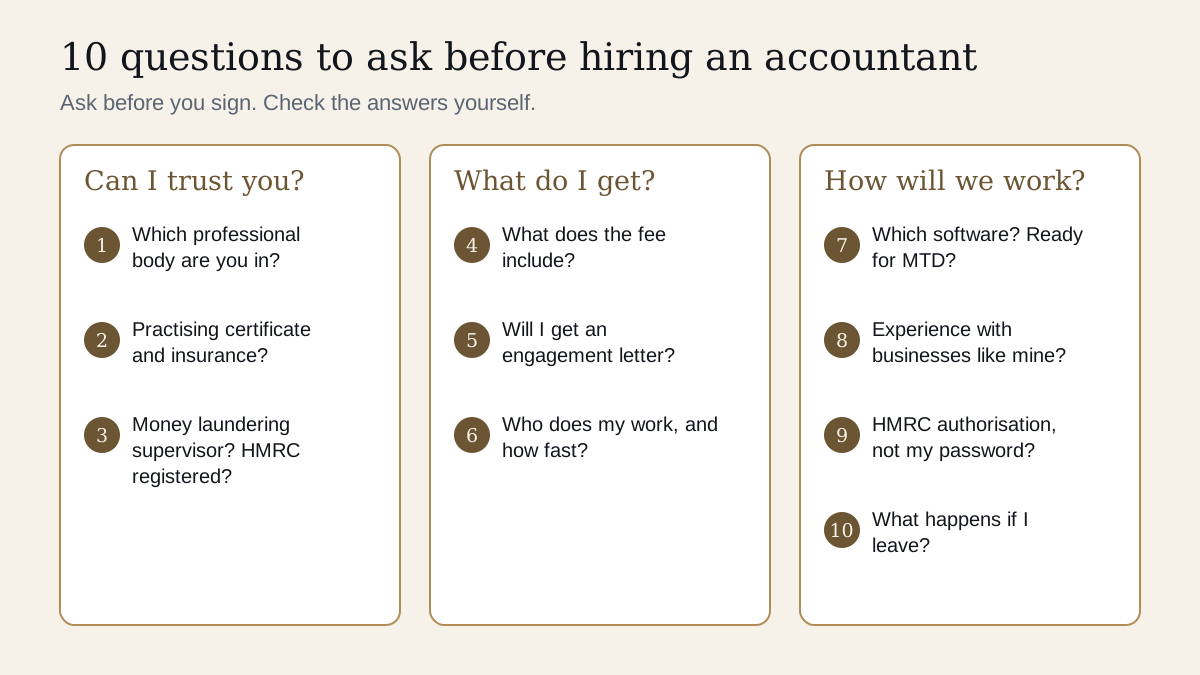
1. Which professional body are you a member of?
Ask which body they belong to and for their name as it appears on its register. The main bodies are ACCA, ICAEW, ICAS, CIOT, ATT and AAT. Each one sets standards for its members.
Then check it yourself. ACCA has a public find an accountant search for members and firms, and the other bodies have their own.
Titles matter too. A "Chartered Accountant" is a member of ICAEW, ICAS or a similar institute. A "Chartered Certified Accountant" is a member of ACCA. Both are qualified. The red flag is an accountant who will not name a body at all.
2. Do you hold a practising certificate and insurance?
Membership alone does not mean a person can take on clients. ACCA's public practice guidance says a member in public practice in the UK "must hold an ACCA practising certificate".
ACCA's practice handbook also says: "Holders of practising certificates must hold professional indemnity insurance". That insurance pays out if the accountant's negligence costs you money.
Other bodies have their own rules. Ask the question in plain words: "Are you insured if you get my tax wrong?"
3. Who supervises you for money laundering, and are you registered with HMRC?
Every accountancy firm needs an anti-money laundering supervisor. GOV.UK says an accountancy service provider "must register with HMRC" unless a professional body, such as ACCA or ICAEW, already supervises it. A good accountant names their supervisor without a pause.
There is a newer check as well. HMRC now requires most paid advisers who deal with HMRC for clients to register as a tax adviser. Registration opened in stages in 2026, from 18 August 2026 for advisers who handle Self Assessment or Corporation Tax.
Expect the accountant to ask you for ID too. That is the money laundering rules at work, not a sign of distrust.
4. What exactly does your fee include?
HMRC's guide tells you to check what the agent charges, and "how and when you're expected to make payment". Ask for a fixed fee in writing, and ask what costs extra.
Common extras are a late-records fee, help with an HMRC enquiry, VAT registration and one-off advice calls. A low monthly price can hide a long list of add-ons.
For typical London fee ranges and how to compare two quotes fairly, see how much a small business accountant costs in London.
5. Will I get an engagement letter before you start?
HMRC tells you to read the agent's terms, including the "legal contract you may be agreeing to". In practice, that contract is the engagement letter.
A good engagement letter lists the work, the fee, what you must supply and by when, and how either side ends the arrangement. Do not hand over records or authorise anyone with HMRC until you have one.
6. Who will do my work, and how quickly will you reply?
HMRC suggests you meet the person who will deal with HMRC for you. At a large firm, that is often not the person who sold you the service.
Ask how they reply (email, phone or a portal) and how long a normal reply takes. Ask what happens in January, when Self Assessment work peaks. A clear, honest answer is better than a promise of "same day, always".
7. Which software do you use, and are you ready for Making Tax Digital?
Making Tax Digital for Income Tax has started. From 6 April 2026, it applies to sole traders and landlords with qualifying income over £50,000. The limit falls to £30,000 from April 2027 and £20,000 from April 2028.
Ask which software the accountant supports and whether you must pay for it. Ask who sends the quarterly updates to HMRC. If you prefer spreadsheets, ask whether they can link them to HMRC with bridging software.
8. Have you worked with businesses like mine?
HMRC's guide says to check the agent has "the right experience", for example in your trade or business size. A construction subcontractor needs someone who knows CIS. A limited company director needs someone who plans salary and dividends.
Ask for a plain example of a similar client's problem and how they dealt with it. You want specifics, not a list of logos.
9. How will you get access to my HMRC records?
The right answer is that you will authorise them as your agent with HMRC. HMRC's guide is direct: never share your HMRC online sign-in details with your agent.
Any accountant who asks for your Government Gateway password is a reason to walk away. HMRC also says not to sign a blank return. Review every return before it is filed.
10. What happens if I want to leave?
Ask how they hand over to a new accountant and whether they charge for it. A confident accountant does not make leaving hard.
Our guide on how to switch accountants explains the handover, HMRC authorisation and the Companies House code.
What are the red flags when hiring an accountant?
- No professional body you can check, or vague answers about insurance
- No written fee and no engagement letter before the work starts
- A request for your HMRC sign-in details
- A promise of a tax refund, or a tax saving, before they have seen your figures
- No interest in your ID. A firm that skips the money laundering checks may skip other rules too.
One red flag can have an innocent reason. Two or more together are a good reason to keep looking.
The bottom line
Before hiring an accountant in London, check three things: who regulates them, what you get in writing, and how they will work with you. Check the professional body yourself rather than trusting a logo on a website.
The best accountants welcome these questions, because they have good answers. If the questions make an accountant uncomfortable, that is your answer.
How REYS Accountants can help
We are a small practice in Catford, SE6, working with sole traders and small companies across South East London. Rehan Razzaq is a Chartered Certified Accountant and a Fellow of the ACCA (FCCA).
Ask us any of the questions above on a first call, with no obligation. See our Self Assessment service, all our services and packages, or get in touch.
Frequently Asked Questions
No. HMRC says anyone can call themselves a tax agent and that HMRC does not regulate agents. Titles such as Chartered Certified Accountant are controlled by the professional bodies, so check membership on the body's own register.
Use the find an accountant search on the ACCA website. It has a directory of members, searched by name, and a directory of firms.
Yes. HMRC says you remain responsible for your own tax affairs when you use an agent. Read each return before it is filed, and never sign a blank one.
It is the written agreement between you and your accountant. It sets out the work, the fee, what you must supply and how either side can end the arrangement.
This article is general guidance for UK businesses and does not constitute personal tax advice. It reflects GOV.UK and ACCA guidance at 12 November 2026. Rules and individual circumstances vary and can change, always confirm your specific position with a qualified accountant or on gov.uk before acting.

Ask us the questions
Put any of these questions to us on a short call. We will answer them plainly, with no obligation.
Book a short call