Blog
CIS Tax Return for Subcontractors: How to Claim Back Your Deductions
If you are a CIS subcontractor, the 20% your contractor takes off is an advance payment of your tax, not the final bill. You claim it back on your CIS tax return, which for a sole trader is your normal Self Assessment return.
Because the deduction ignores your expenses and your Personal Allowance, many subcontractors have paid too much and are due a refund.
This guide covers what CIS takes off, how to claim it back, a worked example and the mistakes to avoid. The rules and rates were checked on GOV.UK on 8 November 2026.
By Rehan Razzaq FCCA · Published · 7 min read
The short answer
- What CIS takes: 20% of the labour on your invoice if you are registered, 30% if you are not, and nothing if you have gross payment status.
- How you get it back: a sole trader puts the CIS deductions on their Self Assessment return, and HMRC sets them against the tax due.
- Refund or bill: if the deductions are more than your tax and Class 4 National Insurance, HMRC repays the difference.
- When: you can file as soon as the tax year ends on 5 April. The 2025/26 deadline is 31 January 2027.
- Limited companies: claim the deductions through payroll on an EPS, not on the Corporation Tax return.
What does CIS take off a subcontractor's pay?
Under the Construction Industry Scheme, a contractor who pays you for construction work must take tax off your pay and send it to HMRC. CIS covers most building work, including site preparation, alterations, repairs, decorating and installing heating, power and water systems.
HMRC sets the deduction rate. It is 20% if you are registered for CIS and the contractor can verify you. It is 30% if you are not registered. With gross payment status, nothing is deducted.
The deduction applies to labour only. VAT, materials you paid for, consumable stores and plant hired for the job do not have CIS taken off them.
So show labour and materials as separate lines on every invoice. If they are mixed together, a contractor can take 20% off money that was only paying for your materials.
How do I claim CIS deductions back on my tax return?
For a sole trader or a partner, the CIS tax return is the Self Assessment return. HMRC's guide to paying tax and claiming back deductions sets out the steps:
- Collect every payment and deduction statement. Your contractor must give you one within 14 days of the end of each tax month, so by the 19th.
- Add up your gross pay. Report your total pay before CIS deductions as your self-employed income, not the amount that reached your bank.
- Claim your expenses. Tools, van costs, work clothing and other business costs reduce your profit. Our guide to what expenses a sole trader can claim lists them.
- Enter the total CIS deductions. They go in the CIS deductions box of the self-employment pages. HMRC sets them against your tax and National Insurance.
- File the return. If you still owe tax, pay it by 31 January after the tax year. If you have paid too much, HMRC repays it.
For the 2025/26 tax year, the online return and any tax due must reach HMRC by 31 January 2027. Our Self Assessment deadline guide covers the penalties for missing it.
Why are CIS subcontractors often due a tax refund?
The 20% is worked out on your gross labour. Your real tax bill is worked out on your profit, after expenses, and only on the part above your £12,570 Personal Allowance.
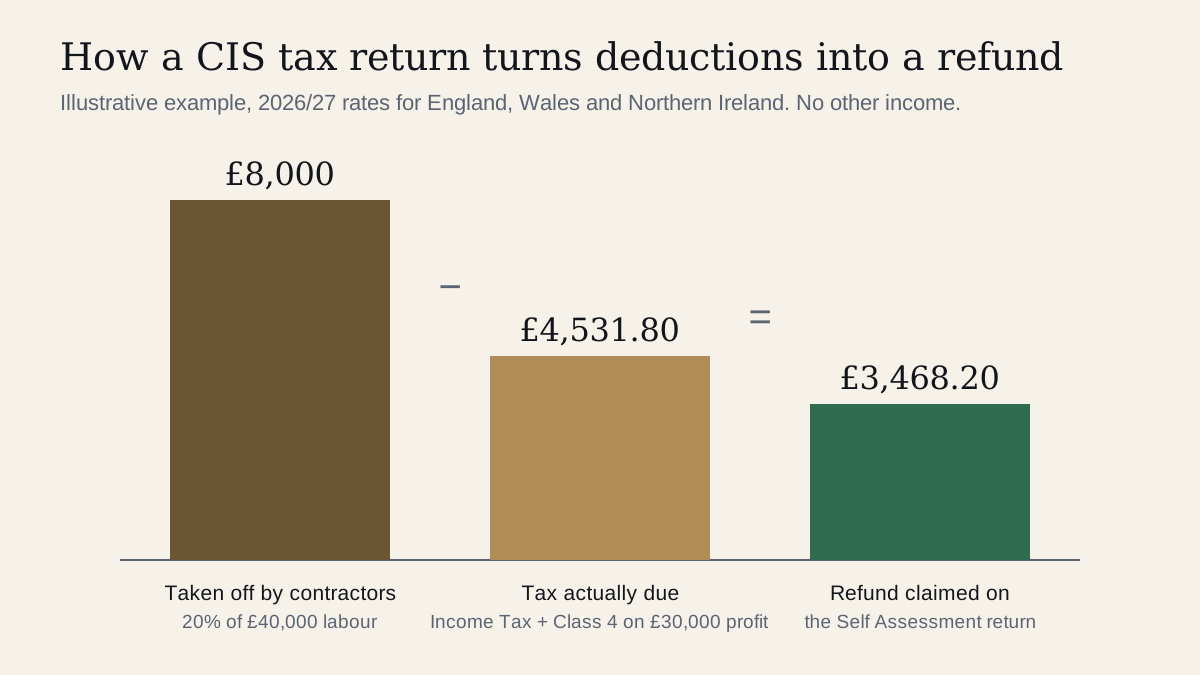
Illustrative example (2026/27, England, Wales and Northern Ireland): a self-employed plasterer invoices £40,000 of labour. Contractors deduct 20%, so £8,000 goes to HMRC. Business expenses are £10,000, which leaves a profit of £30,000.
- Income Tax: £30,000 minus £12,570 is £17,430, taxed at 20%, which is £3,486.
- Class 4 National Insurance: 6% on profits between £12,570 and £50,270, which is £1,045.80.
- Total due: £4,531.80. Already paid through CIS: £8,000. Refund: £3,468.20.
The example assumes no other income. Income Tax bands are different in Scotland, so the figures there would change. Class 2 National Insurance is treated as paid at this level of profit, so nothing extra is due.
What if I work through a limited company?
A limited company does not use Self Assessment to reclaim CIS. Instead, it reports the deductions to HMRC through payroll. The company sends its usual Full Payment Submission, plus an Employer Payment Summary (EPS) with the CIS deductions for the year to date.
HMRC sets the deductions against the PAYE and National Insurance the company owes. Anything unused carries forward within the same tax year, and any balance left at the year end needs a refund claim.
HMRC says you must not use your Corporation Tax return to pay tax with your CIS deductions. Our payroll service covers the monthly EPS for company subcontractors.
Does Making Tax Digital apply to CIS subcontractors?
Yes, if your income is high enough. Sole traders with qualifying income over £50,000 in 2024/25 should have used Making Tax Digital for Income Tax from 6 April 2026.
The threshold falls to £30,000 (based on 2025/26) from April 2027, and to £20,000 (based on 2026/27) from April 2028.
Qualifying income is your turnover, the amount before expenses. For a subcontractor, that means your gross pay, not the smaller amount left after CIS deductions. Many tradespeople cross the £30,000 line long before their profit does.
Can I stop CIS deductions with gross payment status?
Yes, if your business passes HMRC's gross payment status tests. You must have paid your tax and National Insurance on time in the past, and run the business through a bank account.
A sole trader also needs construction turnover of at least £30,000 in the last 12 months, not counting VAT and materials. Partnerships and companies need £30,000 for each partner or director, or at least £100,000 in total.
With gross payment status, contractors pay you in full. That helps your cash flow, but you must then put the tax aside yourself and pay it by the normal deadlines.
What do subcontractors most often get wrong?
These are the problems we see most often when a subcontractor brings us their CIS paperwork:
- Missing statements. Without every monthly statement, the deductions are hard to prove. Ask the contractor for any you did not receive.
- Reporting the net pay as income. Put the gross pay on the return and claim the deductions separately, or the sums do not add up.
- Not splitting materials on invoices. This lets 20% come off money that was never your profit.
- Waiting until January. If you are due a refund, filing in the spring gets your money back months earlier.
- Not claiming expenses. Every allowable cost makes the refund bigger. Keep receipts as you go, as our guide to what records to keep explains.
The bottom line
CIS deductions are tax paid in advance, not tax lost. Register for CIS so you pay 20% and not 30%, keep every monthly statement, and split labour from materials on your invoices.
Then file your CIS tax return early, with your gross pay, your expenses and your deductions. If the deductions are more than the tax due, HMRC repays the difference.
How REYS Accountants can help
We are a small practice in Catford, SE6, and we prepare Self Assessment returns for builders, electricians, plumbers and other trades. We match your statements to your invoices and claim every deduction and expense.
See how we work with trades in Bellingham and Downham, or get in touch.
Frequently Asked Questions
Yes. You can file your Self Assessment return as soon as the tax year ends on 5 April. If you are due a refund, filing early means HMRC can pay it months before the deadline.
Yes. Your contractor must give you one within 14 days of the end of each tax month, so by the 19th. Keep them all, because they prove the deductions you claim back.
Contractors must deduct 30% instead of 20%. You still claim the deductions back on your tax return, but registering stops too much tax being taken in the first place.
A sole trader who stops trading can claim a refund of CIS deductions on form CIS40. A partner uses form CIS41.
This article is general guidance for UK subcontractors and does not constitute personal tax advice. Rules and rates are as published on GOV.UK at 8 November 2026, and the example is illustrative. Rules and individual circumstances vary and can change, always confirm your specific position with a qualified accountant or on gov.uk before acting.

Owed CIS tax back?
Book a short call and we'll tell you what your CIS tax return involves, no pressure, no obligation.
Book a short callCIS for subcontractors